Is Perkins $25 Grab Bag Worth the Cost?

Our local produce stand has a deal where you can fill a bag with as much fruits and vegetables as you want, plus a free item of their pick, for a fixed cost of $25. As a numbers person, I wanted to know– is this a better deal than going to Harris Teeter?

This week, the answer was yes. I only spent $25 at Perkins whereas those same items at Harris Teeter would have cost $26.24, plus I felt good knowing the produce was fresh and locally sourced. If you only need a few things though, it probably makes sense to pay by the item.

Another pro of Perkins– they sell a lot of pumpkins! In typical fashion, they’ll sell you as many pumpkins as you can fit in a wagon, plus a bag of produce, for the reasonable cost of $100.

See you next time

Logan didn’t like to talk about the “c” word, even though it loomed over him every day for six and a half years. It’s something that happened, but it’s not who he was. Logan was smart, funny, determined, and one of my very best friends, and that’s how I’ll always remember him.

I met Logan around 2014 when he joined KA at UNC. In the fraternity world, Logan was my “little brother’s little brother,” which meant that Bobby and I were both supposed to be mentors for him. But Logan was always determined to find his own path and ended up being more of a role model for both of us. Against all logic, he decided to pursue physics, probably the hardest major at UNC, driven by his innate desire to understand how things work, particularly everything related to space. This scientific mindset later led him to earn a master’s degree in analytics.

Logan was often quiet, but when he talked, people listened. Even though he could be serious a lot of the time, he was also funny in his own sarcastic but loving way. One time, I accidentally put milk in the pantry instead of the fridge. Logan was over at my house the next day and opened up the cupboard. He saw the milk and, with a sly smile, said, “Oh cool, you have your own milk shelf,” then closed the cabinet and went about whatever he was doing.

Logan’s passions were simple yet profound: he loved craft beer, Marvel movies, videogames, spending time with friends, and Tar Heel athletics. He proudly wore UNC’s colors through his master’s program at NC State and later through the halls of Duke Hospital. He always knew all the latest stats and transfer portal rumors. For ten years, Logan was my right-hand man at nearly every UNC home football game, the kind of fan who never left early to beat traffic. When he could no longer attend because of health reasons, he made sure the tickets found their way into a friend’s hands to carry on the tradition.

Logan was loved and supported by so many friends, family members, fraternity brothers, classmates, and colleagues. To illustrate what type of friend Logan was, I remember a story he told about going to the beach with his aunt and uncle on a hot day. They knew he loved craft beer but didn’t know much about it themselves, so they got him a six-pack of Duck Rabbit Milk Stout, which would be about as refreshing as a large glass of thick chocolate milk. Logan politely thanked them and pretended to enjoy one to avoid hurting their feelings. I think he told them later on, and they all laughed about it. Another time Logan had brought a first date to a football game, and in an unlucky turn of events, Bojangles sold me chicken tenders that were raw in the middle. I was either too shy or disgusted to do anything about it at the time but Logan and his date graciously offered to “handle it” for me. They returned the tenders to the store and warned everyone in line about what had happened. Bojangles felt so bad about it that they gave Logan and his date triple their money back in cash. They ended the day with a grateful crowd of people saved from food poisoning and a first-date story that left us all laughing.

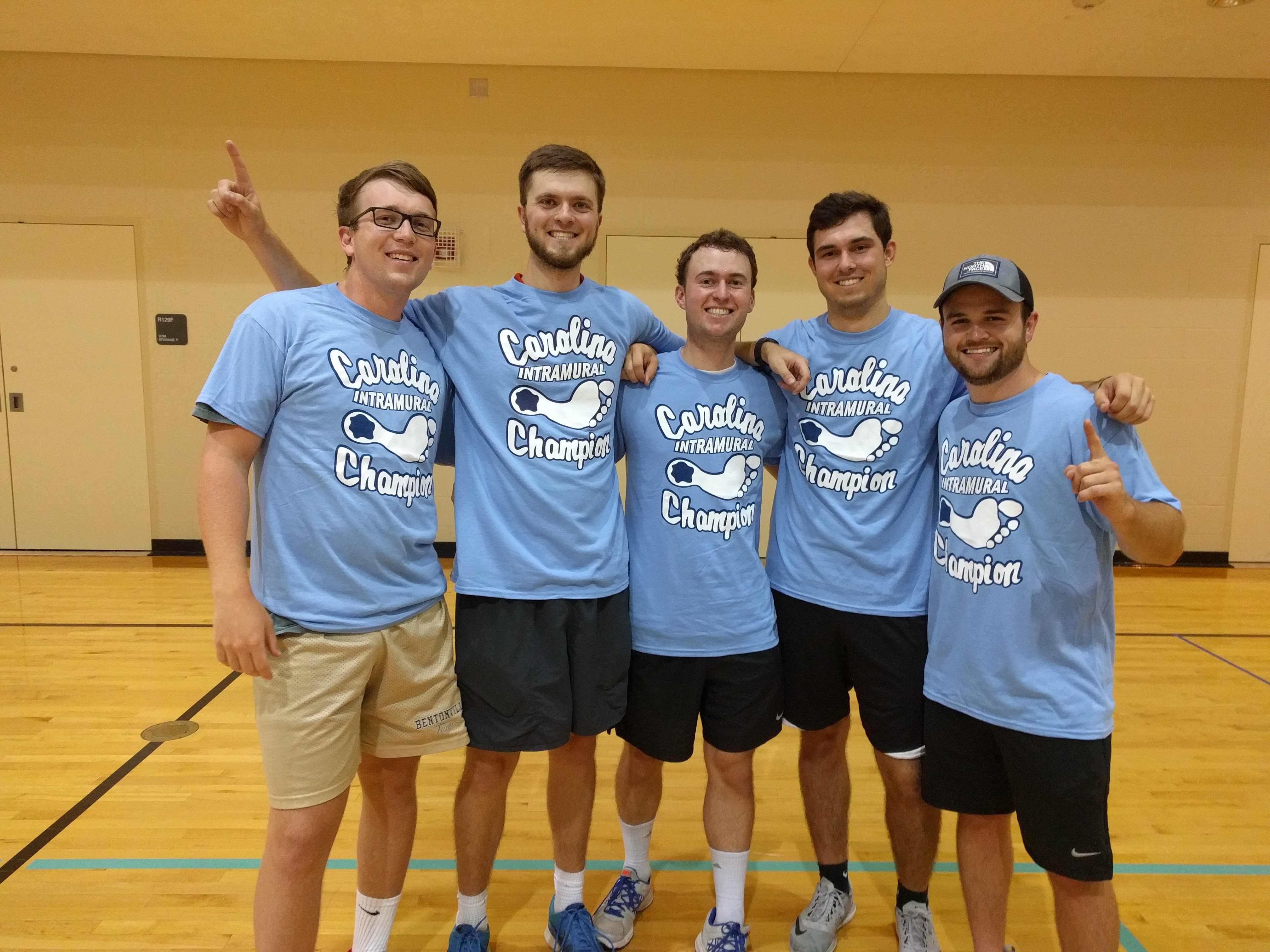
We were playing on an adult kickball team around the time Logan was diagnosed with cancer. I remember taking him to one of his first doctor’s appointments because of what he thought was just back pain at the time. There were a lot of ups and downs over the next six and a half years, including a brief celebration in 2019 when the cancer went into remission. But no matter how hard things got, Logan’s personality always shined brighter than the pain he was going through. He was always there for us, and we were there for him when he needed us. Our close-knit group of friends visited him in every hospital room, offered rides, brought food, and even lodged a formal complaint when the handicap bathroom wasn’t actually handicap friendly. The most meaningful event was when Councill rented out a movie theater, and twenty of our friends came from near and far to join Logan in rewatching his favorite movie, “Interstellar,” on the big screen.

Logan was a great person and an amazing friend, and it hurts to think about how much I’ll miss his quick wit, late-night space talks, sports commentary, and everything in between. But I know he’d want us to hold onto the good memories until we meet again. To his friends and family, Logan didn’t say goodbye—he said, “I love you, and I’ll see you next time.”

Date Night Data: Analyzing Movie Trends and Stats

Over the past year, Brittany and I have embarked on a cinematic journey, watching 46 movies in theaters over 365 days. From Halloween thrillers to box office flops, this has sparked our curiosity to learn more about the trends and insights into the movies we love. Join us as we dive into the data behind movie budgets, ratings, and profits, along with a brief refresher from your high school statistics class.

We prefer to go on Thursday’s when new movies are released. We saw 24 of 46 movies on opening weekend

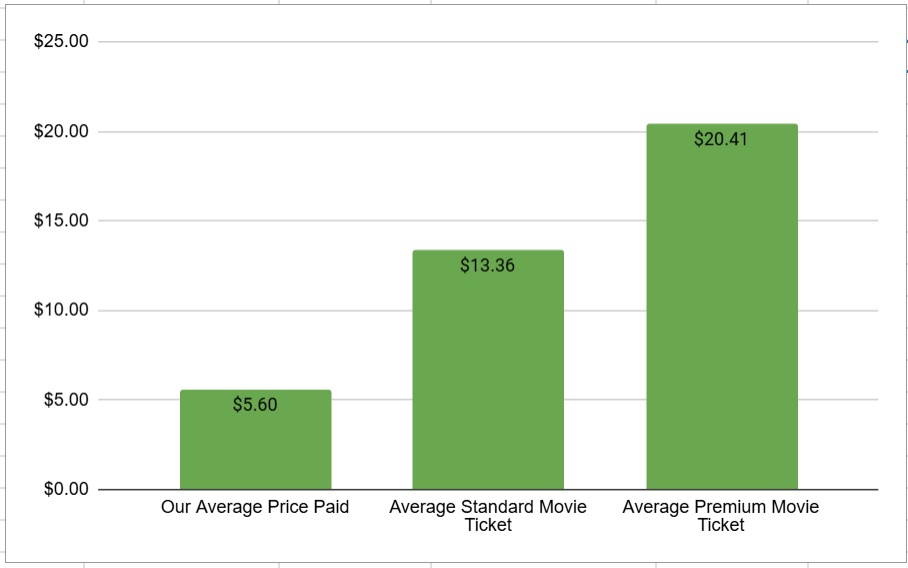
Using the AMC A List (movie subscription pass), we paid ~$5.60 per ticket; 59% less than a standard ticket ($13.36) and 73% less than an Imax/Dolby ticket ($20.41)

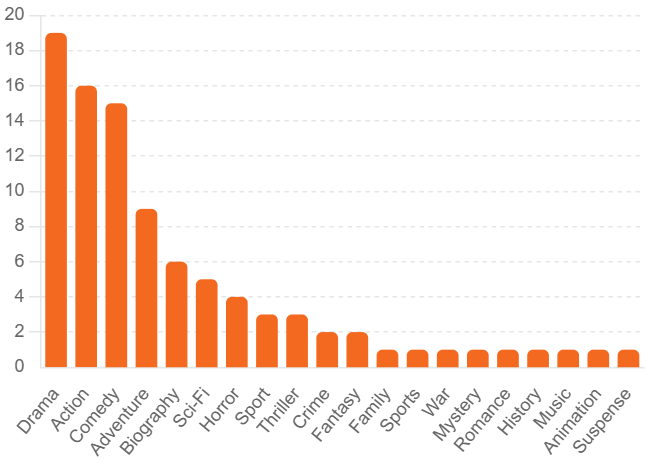
Most of those movies we saw were dramas, action movies, or comedies (note some movies had more than one genre)

We saw six movies from both Paramount Pictures and Sony Pictures

Ready to dive deeper into the stats?

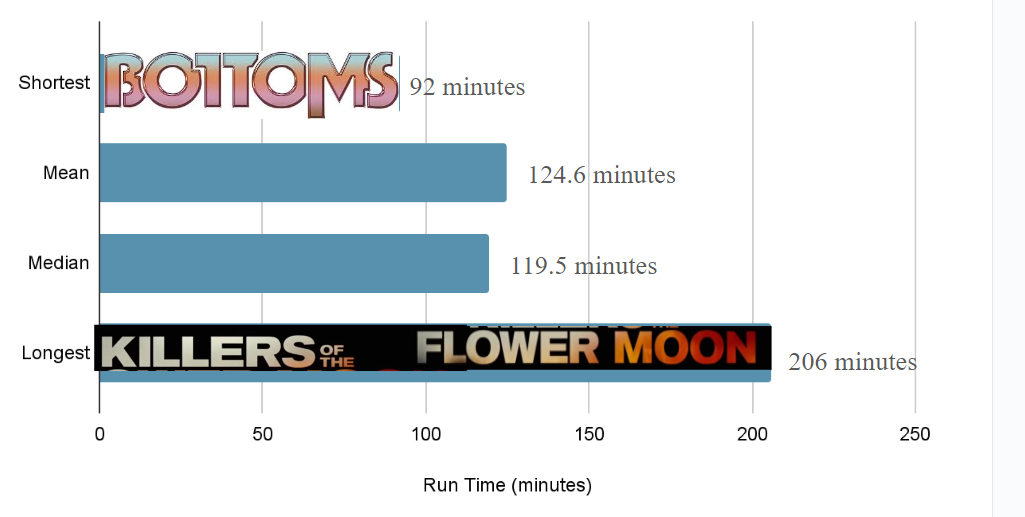
You could watch the shortest movie (Bottoms) 2.2x before the longest movie is over (Killers of the Flower Moon).

Of all the movies, these were the biggest financial hits (at least for opening weekend), generating more box office revenues during opening weekend (red) than the film’s budget (blue)

Generally, the production company gets to keep 50-60% of the box office revenues from opening weekend and the theater owner get to keep the remaining 40-50%. However, this split is contentious and often varies based on the strength of the film and the bargaining power of both the production company and the theater. After opening weekend, that split often shifts over subsequent weeks such that the production company’s cut decreases and the theater’s share increases.

There are plenty of exceptions but opening weekend box office revenue carries an outsized importance because it often sets the tone for the film’s entire theatrical run. By Sunday of opening weekend, studio executives can predict with great accuracy what a movie will earn by the time it leaves the cinema. Ticket sales are the largest driver of income for movies, although not necessarily the most profitable because of taxes and the cut owed to the theater. Other sources of revenue for the production company include DVD sales, on-demand rentals, licensing income from streaming services, and merchandising.

This reliance on opening weekend box office revenues is changing though. Film critic Bilge Ebiri explained, “Hollywood is in the midst of a transition… [they’re creating] Fewer gigantic productions that need massive opening weekends to justify their humongous costs; [and] more solid films that can turn a profit over a few weeks and months thanks to good word of mouth. The smash-and-grab opening-weekend strategy was never going to be sustainable, and the industry had become alarmingly reliant on an increasingly small handful of titles saving their bottom lines.”

This transition may include a larger reliance on sequels and related works. Of the five movies above, four aren’t entirely original stories. Barbie has the doll, Five Nights at Freddy’s is based on a video game, and Spider man and Maxxxine are both sequels. In total, 14 of the 46 movies we watched were direct sequels or part of a movie series, and several more were based on books or other works. TheFilmAutopsy explained sequels “just make more money,” and the limited data we collected tends to agree. On average, a sequel generated box office revenues equal to ~50% of its total budget during opening weekend, whereas novel movies only returned ~41%.

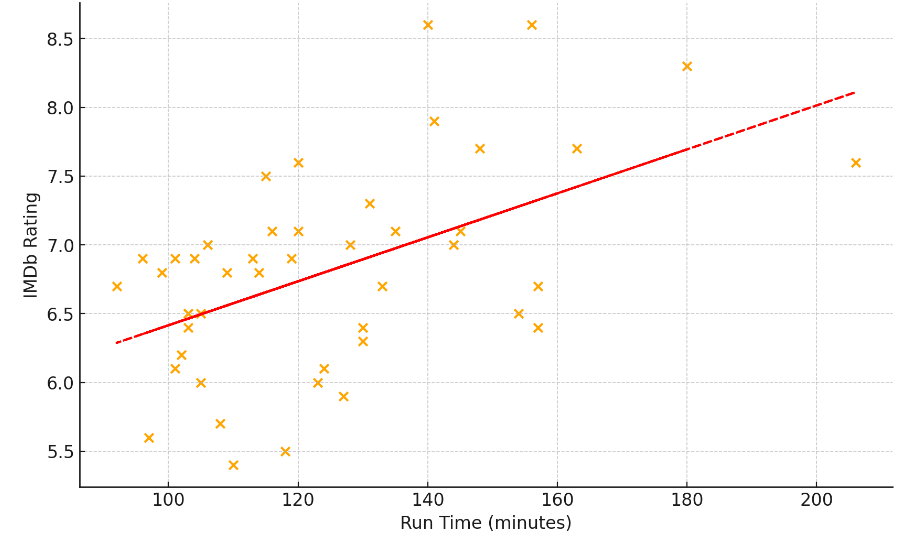
In general, longer movies had moderately better reviews (r=0.52, p=.002)

The correlation coefficient (aka “r” value) measures the strength and direction of the linear relationship between two variables. The value can range from -1 to 1. A value of 0 would indicate that two variables aren’t related at all (like your shoe size and reading ability), whereas a value of 1 indicates a perfect positive relationship between two variables (like degrees Fahrenheit and degrees Celsius). The r value of of 0.52 here indicates there’s a moderately positive relationship between a movie’s run time and it’d IMDb rating.

The p-value helps determine the significance of the results. In this scenario, the p-value is the probability of observing the results below if run time and IMDb rating were not correlated at all (meaning an r-value of 0). This dataset has a p-value of 0.0002 (0.02%), giving us confidence that these results are not random and that there is positive relationship between run time and IMDb rating. To be considered statistically significant, most fields look for a p-value of less than .05.

The line of best fit (aka regression line) shown in red is a straight line that best represents the data on the scatter plot below. The formula for the straight line can be line described by the formula y=mx+b, where y is the IMDb rating, m is the slope of the line, x is the movies run time, and b is a constant representing where the line crosses the y axis. Altogether, we can use this formula to estimate a movie’s IMDb rating as “IMDb Rating=0.016Ă—Run Time+4.817.” The constant of 4.817 isn’t meaningful in itself, but suggest a movie with a run time of 0 minutes (a hypothetical scenario) would have an IMDb rating of 4.817. For every incremental minute, the slope of the line suggest that the IMDb rating would increase by 0.016 point.

This data makes intuitive sense given that longer movies have more time to develop characters and storylines, which could potentially lead to a better overall movie and higher ratings.

But strangely, getting better reviews doesn’t necessarily mean that more people are going to go see that particular movie on opening weekend (r=0.243, p=0.104)

The trend line in red does indicate a weak positive correlation between a movie’s IMDb rating and opening weekend box office revenue. However, the p value of 0.104 suggests that there’s a 10.4% of obtaining this result (or something even more extreme) even if the variables weren’t related at all. Based on that, we can’t confidently claim that higher IMDb ratings correlate with higher opening weekend box office revenues.

Why aren’t these variables more correlated? I had a few theories:

  • Opening weekend box office revenue is probably more related to how much the production company spent on marketing and advertising for the movie beforehand. You’re probably not going to go see a movie that you’ve never heard of, right? I’ll investigate this further below. Note I would have liked to use total box office revenue instead of just opening weekend box office revenue, however it wouldn’t have been fair since several of these movies are still in theaters.
  • More people want go to the movies around certain holidays or peak seasons (like Halloween or Valentine’s Day), even if the movies aren’t that great. For example, Brittany and I went to see the horror movie “Five Nights at Freddy’s” around Halloween and the romantic comedy “Anyone But You” around Valentine’s Day, even though we weren’t particularly excited about either film.
  • Reviews are a lagging indicator. I’ve noticed that a movie’s IMDb rating tends to start out very high and gradually decrease over time. For example, if you go see a movie on opening night, you probably already know that you were going to like the movie before it even started. But as more people go see a movie, the rating usually decreases closer to it’s truer and long-term average. Since these movies all came out at different times, this probably isn’t a fair dataset. Or maybe IMDb is just rigged.

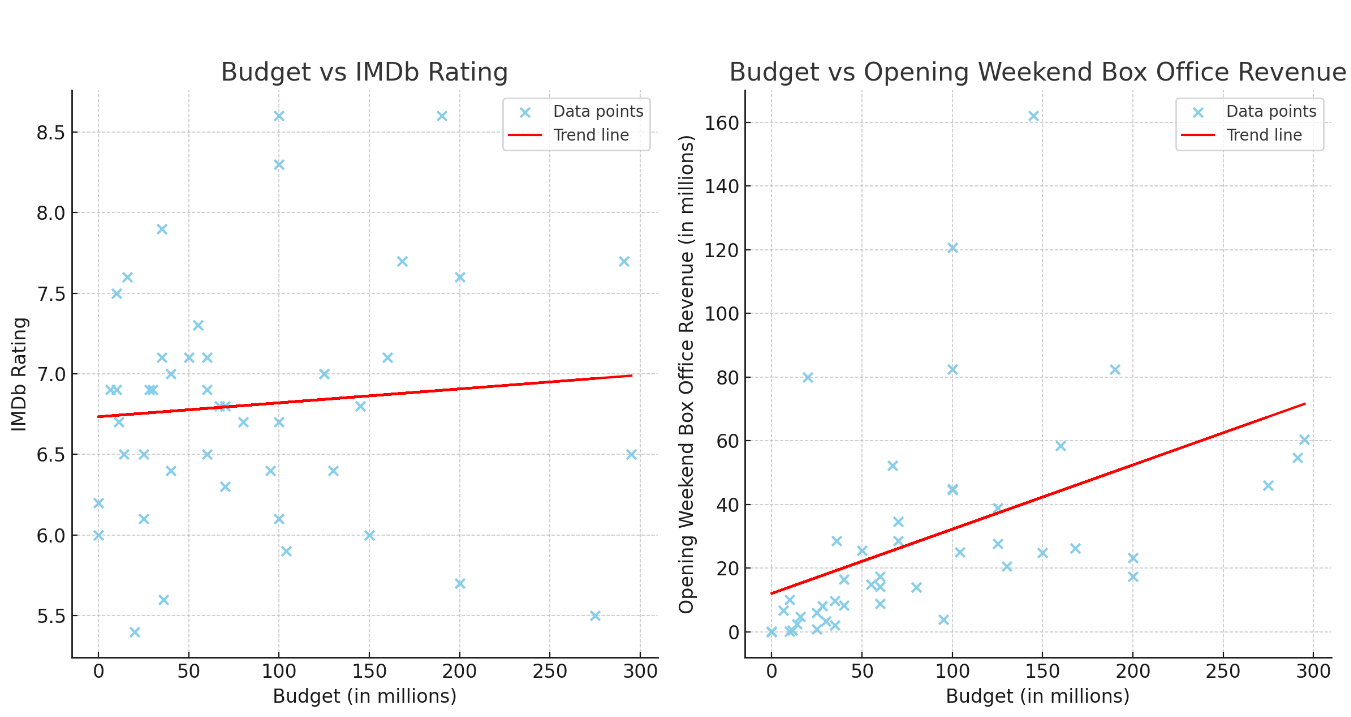
Just like politics, it’s all about the money. Higher movie budgets don’t lead to better reviews (r=.089, r=0.55), but they do lead to higher opening weekend box office revenue (r=0.467, p=.001).

The chart on the left is all over the place, driving home the point that higher budgets don’t correlate with higher IMDb ratings. The r value indicates a weak correlation, however even if that were true, the p-value of 0.55 indicates that there’s a 55% chance that the observed data could occur even if budget and IMDb were totally unrelated. Therefore, we conclude that there’s no significant evidence that higher budgets lead to higher IMDb ratings.

On the other hand, the chart on the right indicates that higher budgets do lead to higher opening weekend box office. This isn’t a surprise. With more money, studios will bring in more famous actors, hire better producers, and spend more money on advertising. The r-value of .467 suggests a moderately positive correlation between a movie’s budget and opening weekend box office revenue, and the p value of .001 gives us high confidence that the correlation is statistically significant. The slope of the trend line (m=.202) suggests that for every additional million dollars in a movie’s budget, the opening weekend box office revenue is expected to increase by approximately $0.202 million (or $202,000).

So what does all this mean?

Our sample size is too small to reach any major conclusions other than we’ve had a great time on our 46 date nights at the movies. We’re looking forward to more movies coming up (Joker 2, Wicked, Bettlejuice, etc.), which may turn into more blog insights, but until then, check out my last movie blog where I’m “Reviewing Movie Reviewers.”

A Leader Among Boys

Steve was the only one surprised when Dr. Golden called out his name to receive Boy Scouts’ “District Leader of the Year” award last month. Over the past 25 years, Steve has earned a reputation for tirelessly serving the scouting community and being willing to take on the jobs that no one else wants to do. He’s driven by a desire to pass on the same skills he learned in scouting, and the many doors that scouting can unlock for kids today. I couldn’t make it to the awards ceremony but Steve smiled as he recapped the event. “I’m not in it for the awards,” he said, “but if you see a need and go do it for 25 years, maybe you’ll get a certificate too.” 

“What can I do to be of help?”

Most leaders know Steve by his famous catchphrase, “What can I do to be of help?” Over the years, these magic words have put him in charge of a lot of different things, like the Great Day of Service, Scout Sunday, Scouting for Food, all water sports related trips, the Eagle Board of Review, and much more. As we continued talking, he walked me through a few of the more challenging roles he’s had in scouting. 

Popcorn challenge accepted:

“It’s got to be the worst job in the troop,” he said. The Popcorn Chairman’s job is to organize a group of 60 boys aged 13-17 into a salesforce to sell popcorn and raise money for the troop. Don, the previous chairman, had just retired from the position and none of the leaders wanted the job, especially since Don had just set a new sales record (and expectation) for the troop to sell $25,000 worth of popcorn. Steve volunteered to do it on three conditions: 1. I’m only going to do it for three years. 2. I won’t handle the money. 3. We’re going to raise the sales goal from $25k to $30k… largely because the people who make the popcorn offer free delivery if your troop sells $30k worth of popcorn.

To make matters worse, it was fall 2008 and the economy was in shambles. Nevertheless, Steve found success by putting the right incentives (prizes) in place for the scouts, recruiting a treasurer (CPA) to physically handle the money, and getting the moms involved, which somehow no one had ever thought of doing. Steve pushed me the hardest, so if you’re reading this post, chances are you probably bought popcorn form me at some point.

Bus on the brink: 

Step 1: Panic. The Scout bus was winding through the mountains of West Virginia when the headlights went completely dark. This wasn’t the first time the bus had put the scouts in a dangerous position, and Steve made the call… “this is the last trip we’re ever taking on this bus.” 

Thank goodness the popcorn fundraiser was a success because Steve a new job— finding, fundraising, and purchasing a new Scout bus. Steve didn’t know the first thing about buying a bus, which brought him right back to Step 1… Panic. Fortunately, one of Steve’s many talents is bringing the right people together to solve a problem. He teared up thinking about the community members who stepped up to get the scouts back on the road including Bob Reddic, who helped find the bus, Bill Marvin, who conducted a rigorous pre-purchase inspection on the bus, Claire Gladding, who generously donated to the fundraising effort, and Robbie Robertson, who let the scouts park the bus at his warehouse after the catalytic converter was stolen. The bus, aptly named “Claire,” is still on the road today. 

Fly like an Eagle: 

After seeing a need, Steve created a new position in the troop called “Eagle Mentor,” to help Life Scouts find and complete an Eagle Project, the last step towards earning the coveted Eagle Award. Without any hand holding, he provides struggling scouts with the framework and opportunity to develop their leadership skills by leading a large scale community service project.  99% of the time, these scouts will rise to the occasion– I should know, as I was his first guinea pig for the program. 

Over the years, Steve has led Eagle Projects at churches, schools, parks, foster cares, community centers, and more. On his dresser, he keeps a small box of “Eagle mentor pins,” given to him by scouts after earning their Eagle awards. Steve eventually put all of his learnings into a handbook, which is now a required part of the Eagle project process. So you could pretty much say he wrote the handbook on how to get your Eagle Award. 

A legacy of service, looking forward: 

Steve’s scouting journey isn’t over though. Over Easter, we attended a church service at St. Andrews in Winston-Salem, where Steve had helped coordinate a massive Eagle Project to build a community garden. The pastor was telling the church about how he got a call from Steve the very next day after finishing the project. He figured someone had left their hat or something but Steve just had one question– “What else can we do to help you?” 

Celebrating the Career and Retirement of Laura Kelley

After a storied career, Laura Kelley is officially retired. Looking back, she said that life is all about chapters. Some short, some long, but there’s usually a common theme, which in her case, is her unique ability to write, and her steadfast dedication to her family. Her biggest advice for others: If you’re bored, learn something new. Life can change fast too– in just a few years, she went from working at a ski resort in Colorado to becoming the director of communications for a hospital system. 

Chapter 1: Humble beginnings 

Laura had no idea what to do after graduating from Emory with a history degree. But she knew she could read and write, which led her to cold-call the Auburn-Opelika newspaper and ask for a job– Not any job in particular, just a job. They hired her on the spot as a proofreader. A few weeks in, Laura realized she could write as well as, if not better than, the staff reporters, so she decided to teach herself how to write for the paper by reading and analyzing articles. 

Eventually the newspaper needed a reporter and Laura was in the right place at the right time. She was charged with covering a federal court case against the Lee County Board of Education, wherein the school board had allegedly engaged in a wide range of activities “designed to maintain segregated public education throughout the State.” This article earned Laura a full time promotion to reporter and a regular beat following the Opelika police department. Her biggest story was following a natural gas explosion at the Kopper Kettle restaurant, which decimated downtown Auburn. Thankfully Laura got to report that no one died. 

In an age where everyone read the newspaper, the community collectively recognized Laura’s writing skills, which helped her land a job as a feature writer for Auburn’s public relations department. Her articles now had an even wider reach, and were picked up by several newspapers around the state and at least one was included in the Auburn football program.  Laura said this was her favorite job ever because she had the freedom to write about anything she wanted. But eventually, that freedom was no longer enough and she looked West for her next adventure. 

Chapter 2: Laura Kelley, master of her own destiny 

With a sense of adventure and without a plan, Laura moved to Breckenridge, Colorado, to work in the ski ticket office; partly because it would afford her the ability to go skiing every day.   Outside of the ski season, Laura worked a series of odd jobs. One year, her roommate got her a job with the city’s water department, where Laura led special projects like painting fire hydrants and color-coding various pipes. Another winter, it didn’t snow until January, and Laura had to take a job at Pizza Hut while she desperately waited for snow so the ski resort could reopen. 

She never gave up on her writing though, and took a freelance job working at the local paper. Her most memorable piece was writing about the resurrection of the Tabor Opera House, a small theater that had hosted famous acts like Buffalo Bill and Harry Houdini during Leadville’s mining boom in the late 1800’s. While not directly a result of Laura’s article, the theater’s ongoing resurrection has been well covered by the national media, including a segment on 60 Minutes. 

While visiting her parents back home in Auburn, her neighbor told her that getting an MBA was “the key to doing whatever you want, ” which sounded pretty enticing. So after exhausting her dream of skiing every day, she mailed off applications to the University of Colorado, William and Mary, and Wake Forest. 

Chapter 3:  Going Corporate 

After being accepted at all three MBA programs she applied to, Laura enrolled at Wake Forest and moved to Winston-Salem. Business school wasn’t what she expected though– Laura was a gifted writer and the school’s “case study” method didn’t jive with her. The program didn’t have lectures or textbooks (her preferred learning method); instead the professors would go around the room with pop-quiz style questions, and then base your grade on your answers. By the one-year mark, several students had flunked out, and Laura was considering quitting too. She called her dad but before she could get a word in, she clearly remembers him telling her “I’ll be proud of you no matter what.” This gave her the courage to push forward and rise to the top of the class. 

Shortly after graduating, Laura accepted her first corporate job as an assistant product manager for Wachovia. It was an important position but stymied by layers and layers of management. One of her big projects was redesigning the customer monthly statement but none of the other departments would agree on which font to use, leaving Laura stuck in the middle. Later on, the arguments centered around whether Y2K was really going to be the end of the world, and if so, how Laura should communicate that to clients. It wasn’t the sort of creative writing she was looking for though, so she looked for a window out as the company was going through a tough merger.  

This led to her next  job as the marketing and public relations director for a small psychiatric hospital system. She got the professional writing experience she had been looking for, however this company ended up having their own corporate problems too. Over a period of just six years, the hospital changed names three times, and Laura had to restart the whole name change PR campaign again. On top of that, the system had just gone through a leveraged buyout, which led to new stresses and pressures that were impeding on her precious family time. 

Chapter 4: Family First

Just after I was born, my mom decided to wholeheartedly focus on her highest calling, being a mother. She (temporarily) left behind her successful career to take Erin and me to Sciworks, Discovery Zone, Shaffner Park, and, if we were good, McDonalds. She never stopped writing, though this time she wrote newsletters and marketing materials for my dad’s construction company, Reliable Builders. 

After I started Kindergarten, Laura had more free time and yearned to rejoin the workforce, but this time something more altruistic than her previous corporate jobs. She was delighted to start working part-time at Senior Services, a non-profit that focused on meeting the needs of lower income senior citizens in the community. Laura was responsible for marketing and building connections  with corporate partners to help pay for other programs like Meals on Wheels. It was the kind of job that left a warm feeling in your heart, and made even better by a great boss.

Family came calling again in 2005, although this time it was my dad. By now, he was running a successful construction business but kept running into the same problem– realtors were eating up a large part of the profit to sell the houses he built. My mom, with her many talents, figured she could sell my dad’s houses just as easily as the next person and got her realtors license. The plan worked perfectly until 2008 when the housing market crashed. Between the cost of the house and all the fees to list and sell the house, my family had too much money tied up in real estate, so my mom went searching for a more steady paycheck. 

Working in the support services department at a law firm wasn’t her dream job, but she figured she could stick with it for a year or so and then move on. Things ended up being better than she thought though. She made a great group of friends and at 5pm she could “punch-out” and still have time for her book club, knitting club, and writing just for fun. 

Chapter 5: Into the Unknown

Laura officially retired on December 22nd but her book isn’t over– In fact, it may just be getting to the good part. With her new free time, she plans to volunteer as a docent at the Reynolda House, help kids with reading at a local school, and even… build out her own blog!! So far, she’s shared recipes, books, and skincare recommendations from her side hustle as an independent consultant for Rodan and Fields. But most of all, she’s looking forward to sleeping in (until 6:30) and spending time with our growing family. 

Retirement feels a little bit like restarting at chapter one, but with Laura writing her own next chapter, I’m sure it’ll be her best yet. 

Want to see more? Check out these pictures from my Mother’s Day post. 

Recapping One Year of Marriage

It gets better every day. Over the past year, we’ve settled into our new home, went on an amazing honeymoon in Mexico, and cherished the ups and downs of every day life. And part of that happiness is due to the great advice we received from friends and family along the way, including:

My sister, who evidently watches a lot of TV

“I’ve learned a lot about marriage from watching Family Feud.

  1. Support your team – even if the answer is not the best, respond with “good answer,
    good answer” Same goes in marriage, support one another’s dreams and goals and be
    each other’s biggest cheerleader
  2. When asked after a lighting round, always say “we wanna play, Steve!” – I hope in your
    marriage you’ll always be willing to play, take a risk and go all in. And finally,
  3. Win or lose, celebrate and act like you just won the prize – This one is
    pretty self explanatory, but have fun and hold each other tight during the good and hard
    times that life may bring you.”
Erin

Carol, who knows exactly how to lighten the mood

“I know I’m supposed to offer up relationship advice, but I’m single with a cat, so what do I know?! So here’s a Mad Lib from the wedding party instead:

What’s some advice that’s worth its weight in STEEL? First, let’s be real. FLOOFY disagreements are inevitable and can be as petty as fighting over whether to order curried CHEESECAKE or CHOCOLATE MOLTEN CAKE. Just remember that a(n) SPICY wife is a(n) HAIRY life. And when you act like a KERFLUFFLE, just apologize! Get in the habit of saying BYE BUDDY, HOPE YOU FIND YOUR DAD! And never go to bed BOTHERED

Remember to fan the DOGS of romance. Draw up a luxurious SMIRNOFF ICE bath and light some UN-SCOOPED KITTY LITTER scented candles for your beloved. But in all seriousness, the most important advice I can offer is to choose to love each other every day, even the hard ones, and always have fun.”

Caroline

Becca, who must’ve had a bad experience in the past…

“Get the absolute best Christmas tree stand you can. It’ll save your marriage.”

Becca

Garrett, my big brother from another mother

“Savor all the time you can and make mental images. But also make space for yourselves and remember it’s okay to be a little selfish with your time and preferences.

Garrett

Carter, quoting Nickelback

“I’m gonna trade this life for fortune and fame. I’d even cut my hair and change my name… Hey, hey, I wanna be a rockstar”

Carter

Brittany’s uncles, who have collectively been married for a very long time

“See if you’re still smiling in 25 years. LOL.”

Danny, Wayne, and Nick

Bobby, who forgot I’m a practicing martial artist

“Conflict is good sometimes.”

Bobby

Casey, who can rock the piano and your heart

“Love is like a pool. Take the plunge and meet in the middle where you’re both the most vulnerable.”

Casey

Brittany’s dad, the most photogenic person in the room

“Just keep doing what you’re doing.”

John

Who’s the best at memes?

I’m in an exclusive small group that trades marginally politically incorrect memes that you probably wouldn’t want your grandmother to see. The group, aptly named “send memes,” has some of my best friends, some of my friends’ friends, and even a few celebrities like Dwayne the Rock Johnson (who was added against his will and never actually opened the chat). By now you probably already know I like to rank things, so let’s dive in. Who’s the best at finding and sharing memes?

The results were measured by looking at every meme posted in the group over the past three years and keeping track of which posts got the most “likes,” and who sent them. There’s probably over 5,000 memes in the chat but the “best of the best” memes all have at least six “likes” from the group, and usually involve satire, poking fun at PC culture, an irreverent twist on current events, or strangely, The Lord of the Rings. So here are the winners and losers, ranked by the number of memes submitted with 6+ “likes.” I’ve also included a sampling of each person’s top memes.

Ryan, Jimmy, and Wes were neck and neck heading into the fourth quarter but Ryan ultimately pulled away with the most consistent (meme) running game

1st Place: Ryan

With eight memes on the leaderboard, Ryan was the clear choice for the winner by volume. His posts generate widespread acclaim for mocking the absurdities of modern life; specializing in pop culture and office humor. Ryan is your bread and butter RB1.

2nd Place: Jimmy

A close second, Jimmy puts up powerful memes that bring back some serious childhood memories like binge watching Lord of the Rings, playing Pokemon Yellow until 4am, and fighting with your friends over the Halo controller. This friendly rivalry could turn into an all out fist fight come playoff season.

3rd Place: Wes

Wes is a serious contender, having shared the most popular meme ever in the group shown below. I don’t totally understand it but I guess everyone else does. Regardless, Wes’ has an undisputed monopoly on timely and spicy memes on current events.

4th Place: Luke

Luke is a dark horse candidate that could blast into the top 3 on a moment’s notice. He can take any scenario and spin it in a completely different direction with his sinister humor.

5th Place: Thomas

Thomas is the group wildcard. He excels in finding obscure accounts and going straight for the shock factor. Some of his posts don’t always land but when they do, they’re big.

Tied 6th Place: Sean

I expected a better performance out of Sean since he largely brought this group together. He’ll sneak in with some fire memes but we really need to see more from him.

Tied for 6th Place: Addison

Addison has strong potential based on his quick trigger for being the first person in your contact list to share viral memes. He’s down on the list but don’t count him out.

7th Place: Jeff

Jeff deserves to keep his starting position but we’d keep him near the bottom of the batting order. Even so, he’ll impress you with you his brashness and absurdity. Daniel Radcliffe rapping? Classic.

Tied for 8th place: Andrew

I like Andrew because he’s okay making a joke at his own expense. Let’s keep an eye on him… and his hairline.

Tied for 8th place: Zach

Back in the day Zach was a mean linebacker for our high school football team. Nowadays he’s the king of dad jokes and often reminisces about we would’ve been state champions if coach had put him in in the fourth quarter. Is Zach a “has been” or is he just getting starting with his new career in the meme game? I’m thinking its the latter.

Tied for 8th place: Eric

Covid-19 led to some of best memes of our generation. However these memes became a dime a dozen as Covid dragged on. We’ll have to wait and see if Eric can tread water in the new meme environment.

The Loser’s Circle:

These guys have never even had the courage to dream about standing on the winner’s podium. They’d rather fake a tummy ache than go up to bat with the game on the line. In fact, over three years and thousands of at bats, they’ve never even gotten on base. Their memes are old, tired, or non-existent.

  • Andrew
  • Dwayne The Rock Johnson
  • Neal 
  • Carter
  • Bobby 
  • Scott
  • Josh
  • Ashley
  • Graham
  • David
  • Jeremy
  • Alex
  • Matt

Honorable Mention Memes (shared by Ryan)

Reviewing Movie Reviewers

It all started with the “Barbenheimer.”

And now, 60 days later, I’m exhausted. Brittany and I have seen 11 movies (in theater) over the past two months. After learning that movie tickets can now cost up to $20.41 (no joke), we signed up for the AMC “A list,” a subscription service where you can see up to three movies per week for a monthly fee of $21.50. Our mission, which we chose to accept, was to see as many movies as possible to get our monies’ worth out of the subscription service. With the period coming to an end, I wanted to answer three key questions about movie reviewers:

1. What’s the difference between the different rating sources?

User Based Reviews:

IMDb scores are based on a weighted-average rating of all registered users (meaning everyday people). This is supposed to give you a good idea of what normal consumers think of the movie. However not all votes carry the same weight, which was designed to prevent individuals (or groups) from rigging the rating. IMDb says they don’t disclose that calculation “to ensure [their] rating mechanism remains effective.” Like many other user-based review sites, the biggest pitfall is that most people only submit a review when they have very strong positive or negative feelings about a movie, which skews the ratings in favor of either enthusiastic supporters or strong critics.

Audience Score, by Rotten Tomatoes, is similar to IMDb in that it represents the percentage of everyday users who rated a movie or TV show positively. There isn’t much information available on how the final score is tallied or if there are any weightings. Regardless, similar to IMDb, this score is susceptible to review bombing or inflated ratings by franchise cults.

Brittany’s Ratings. Brittany is my most trusted movie companion to see all these movies. Not only do we share similar tastes, but we get to experience these movies together, which whether we admit or not, does matter. For example, the theater was freezing cold during Haunted Mansion which literally created a chilling atmosphere. Or during The Equalizer 3, the projector was out of focus for the first 45 minutes of the film, leaving us both annoyed.

Critic-based Reviews:

The Tomatometer, by Rotten Tomatoes, is a score based on the opinions of hundreds of film and television critics. It gives a quick and reliable idea of whether a movie is worth watching. However, the biggest issue with the Tomatometer is that it breaks down complex opinions into a “Yes” or “No” score, and takes the simple average. So if every critic scored a movie 2.5 of out of 4 stars, the Tomatometer would consider all of those positive reviews and give the film a 100% rating, whereas a simple average would give the movie 62.5/100.

Metacritic collects reviews from a broad range of critics and aggregates them into one “metascore.” The individual scores are averaged but somehow weighted according to a critic’s popularity, stature, and volume of reviews through a secret process. Several people still consider this the most balanced aggregate score.

Source

2. Why are the ratings so different?

Using the 11 movies Brittany and I saw over the past 60 days, we can pull out the following takeaways:

A. User-based review sites seem more likely to be impacted by manipulation.

  • Compared to a professional movie critic, individual user ratings from IMDb and “Audience Score” seem more likely (or easier) to be influenced by hype, controversy, or organized efforts to flood a score with either overly positive or negative reviews to manipulate the score.
  • For example, the “Audience Score” seems particularly unreliable. It gave “Haunted Mansion” an 8.4/10, a surprisingly high rating compared to Metacritic (4.7), the Tomatometer (3.8), and my own rating (5). The film was notoriously a box office flop, only grossing $24M at the box office during opening weekend. Could Disney have paid or influenced users to leave positive reviews on the “Audience Score” to artificially inflate the movie’s score?

B. Weighted averages tend to lead to lower average scores.

  • IMDb and Metacritc both openly state that their scores are subject to some sort of behind-the-scenes weighting formula, whereas the Tomatometer is based on a simple average. The “Audience Score” doesn’t say whether it’s weighted or not, so I’ll assume it’s a simple average.
  • The average rating was 7.28 for IMDb and 6.66 for Metacritic; both lower than the simple averages taken from Tomatometer (7.68) and “Audience Score” (8.45).  This could be because the former sites exclude (or dilute) outliers and suspicious reviews like we saw with “Haunted Mansion” in section A. This also may help explain why user-based scores for IMDB and “Audience Score” are so different; because of weighted averages.  

C. Critics often rate movies lower than everyday movie goers.

  • Critics and audience members often have different criteria for evaluating films. For example, critics often consider cinematography, artistic value, and other technical aspects. Audience members, on the other hand, may be more influenced by sampling basis (i.e. only going to movies they’re likely to enjoy and rate highly), herd mentality (i.e. if Brittany likes a movie I’m inclined to agree with her), or the entertainment factor (i.e. the number of explosions).  
  • This discrepancy was most apparent for “Gran Turismo.” Metacritic’s score of 4.8 was significantly lower than the user based reviews from the “Audience Score” (9.8) and IMDb (7.4). Brittany and I also rated the movie high at 9.3 and 9.5 respectively. On the other end of the spectrum, Metacritic rated the artistic film “Asteroid City” at 7.4, higher than IMDb (6.7) and the “Audience Score” (6.2).

3. Which rating service most closely aligns with my own ratings?

My own ratings most closely align with the Tomatometer, however, I don’t think the Tomatometer tells the entire story by itself. I’d look to IMDb first given that A. My personal rating is more likely to align with other audience members (rather than critics) and B. IMDb appears to do a good job of sorting out outliers and manipulation.

To wrap it all up:

Ratings don’t always make sense. They can be good guides, but the magic of the cinema is largely rooted in your own personal taste and connection to the film. My favorite part of the movie-going experience has been the excitement of being in a sold out theater on opening night, always having something to talk about around the office water cooler, and having a weekly date with Brittany.

Oh and Nichole Kidman is annoying.

Saying goodbye

I held onto my grandparents 2002 Toyota Camry a lot longer than most people would have. It wasn’t just a car to me, it was a symbol of coming home and bringing people together. Whether it was seeing my grandparents pull into the driveway, or being 21 and coming home from college to visit my parents, this car has taken me to, and through, a lot of key life moments. Unfortunately, all good things eventually come to an end, and it’s finally time to say goodbye.

My grandparents Clarke and Peggy originally bought this car new from Dyas Toyota in Auburn, Alabama in 2002 for $18,970. The car went on to live many different lives over its 22 years of reliably serving the Holloway/Kelley family. Its first chapter began with shuffling grandkids around, attending Auburn football games, visiting family, and driving between bridge club (Peggy) and the golf course (Clarke). My sister and I would tag along in the back seat and my grandparents always had to put down the armrest in between us as a physical barrier to keep us from fighting. And there was always, always, chewing gum in the center console, which I later learned was because my grandfather had acid reflux, just like me.

When I got to middle school, the Camry stopped going to the driving range as much and spent a lot more time traipsing between doctor appointments. In March 2008, the car took us to my grandfather’s funeral. Not long after, the car moved east as my grandmother moved into the Salemtowne retirement community in Winston-Salem to be closer to us. Her eyes were getting weaker around the same time I got my learner’s permit, so I’d drive the Camry over to visit and some days we’d go out for a drive with no destination in mind. But most times we’d go to Allen’s Dairy Treats since no one could make a hamburger as good as them.

In November 2009, I passed the drivers education test in the front seat of the Camry. Being a high school kid, I didn’t have a lot of money so my dad taught me how to do basic maintenance like changing the oil. However, I used the little money I had to put in a new radio along with a set of subwoofers in the trunk that I bought off Craigslist. That part didn’t last long as I blew the subwoofers by playing it too loud. Around April of 2011, my dad and I spent all day shining up the Camry in the driveway so it looked just like the day it left the showroom (nine years ago at this point) to take me to the high school prom.

I graduated from high school in 2012 and the Camry followed me to Chapel Hill. Around September 2013, I picked up my future wife Brittany in the Camry for our very first date to go to a play at Playmaker’s Theatre on UNC’s campus. Unfortunately by this point my grandmother had passed on too. Both of my grandparents would have really loved Brittany. Especially my grandmother– I’ve never seen anyone read as many books as the two of them. After college, Brittany left town to attend ECU’s Physician Assistant school. The Camry didn’t have auto-pilot but it could just about drive from Durham to Greenville by itself since I made that trip so many times. In December 2022, the Camry drove Brittany and I to our wedding in Greensboro (note we drove home in a badass Cadillac). And around that same time, the Camry pulled into the driveway of our very first home together.

This is a bittersweet goodbye for sure. Don’t get me wrong I’m excited to get new features like a built in GPS, but I’ll miss my grandparents paper maps in the backseat pocket, and always having chewing gum in the center console.