Calculating Savings from a High Efficiency Heat Pump: A One-Year Follow-Up

A little more than a year ago, my HVAC bit the dust and I replaced it with a new high-efficiency heat pump. I wrote about this extensively in the post, How to heat (and cool) your home: Choosing between Natural Gas and an Electric Heat Pump. In that post, I promised a one-year follow-up, and have spent the past 12 months combing through every utility bill to bring you these insights.

My annual utility bill dropped by 11% after upgrading to a high-efficiency heat pump

In the simplest sense, my annual utility bills went down by 11% ($283.79) between 2024-2025 (with the old system) and 2025-2026 (with the new system). This was pretty close to my projection of 13% when I bought the system, however, that projection assumed that energy prices would remain the same, which, unfortunately, is not the case.

After adjusting for higher energy prices, the savings rate was closer to 18%

Between these two periods, the average price of electricity went up by 4.28%, and the average price of natural gas went up by 13.70% (note inflation was around 4.2% during this period). This helped justify my decision to move from natural gas to electric heat, but brace yourself… Duke Energy is currently seeking to raise electricity rates by 11.6% starting on January 1, 2027.

To strip out the effects of the higher energy prices, I went back and applied the 2025-2026 energy rates to my 2024-2025 utility bills. In this scenario, my “adjusted” utility bill for 2024-2025 would be $2,801.43 (a $210.78, or 8% increase, from the actual total of $2,590.65). By comparing the 2024-2025 “adjusted” utility bill of $2,801.43, to the 2025-2026 actual utility bill of $2,306.86, the new system actually helped save $494.57, or 17.65%!

I wasn’t able to adjust for the different weather between the two years, however, according to memory (and ChatGPT), the 2025-2026 period had colder winters and hotter summers that the previous year. This means that the new system likely had to work harder in the latter period, which downplayed some of the cost savings. We reasonably kept the thermostat at the same temperature across this two-year period, so I assumed that didn’t affect these calculations.

I saved money on both cooling and heating my home, although the biggest savings came from the more efficient cooling

Swapping the air conditioner from a SEER 13 to a SEER 17.5 was a pretty big upgrade. On paper, the new system should reduce energy consumption for cooling the home by 25.7% (1-(13/17.5)). After adjusting for the rate hike in 2025/2026, my calculated savings on cooling between June-Aug. 2024 and the same period in 2025 was 24.41%, so that calculation was pretty spot on. The savings from heating was also significant (12.4%-18.6%).

So the new system will pay for itself in… 28.5 years?

It’s not worth buying a new HVAC system just to lower your utility bills. But if you’re buying a new system anyway (like when mine broke), it’s worth considering a high-efficiency model. It may cost more upfront, but you should be able to get the difference back pretty quickly.

For example, the upfront cost of the high efficiency system was $17,500, whereas I also got a quote for an entry-level system from Sure Comfort for $14,500. So the high efficiency system cost $3,000 more upfront BUT I also got a $2,000 tax credit and $1,400 in rebates from Duke Energy. After accounting for the credits and rebates, the nicer system actually saved me $400, and that’s not even accounting for the energy savings and increased reliability of the nicer system! The federal tax rebate has since expired, but it’s still worth looking into local rebates, and factoring in energy savings over time.

If you’re looking for a heat pump, the two key numbers to look for are the SEER rating (how efficient the air conditioner is) and the Coefficient of Performance, or COP (which measures the efficiency of the heating system). With both numbers, higher is better. I’d recommend looking for an Energy Star rated model, and one that has a “cold climate” designation. Check out last year’s blog for more to get into the weeds on efficiency.
Loyalty is Overrated

I got a wakeup call on February 9th, 2017. It came in the form of an unexpected email from Nationwide. It read, “Hi Ryan. Your dad and I were talking about the car insurance this morning and he wants me to quote your 2002 Toyota Camry on its own policy for you.”

This was my dad’s tough love way of kicking me off the family insurance plan and I was pissed. Especially when I got the bill in the mail for $1,023.16. But it did help me learn an important life lesson… loyalty is overrated. Have you ever seen the Geico commercial claiming that “15 minutes can save you 15% or more on car insurance”? Well, it took a lot longer than 15 minutes but my record is 46%. By 2018, I’d dropped the comprehensive insurance on my aging car to get the premium down to $776 (24% savings), and then scored another 29% savings by switching to Erie at $552/year (which was down 46% from that original Nationwide bill).

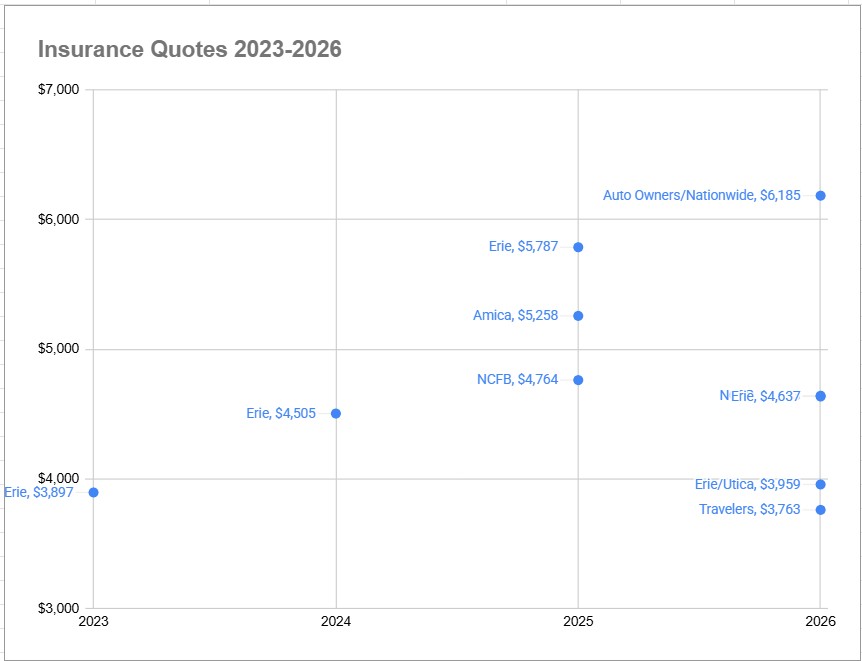
Over time, I’ve collected quotes from 13 different insurance carriers and changed companies three times. I know that seems ridiculous but then again between 2023 and 2025, my insurance bill with Erie went up by 48% ($3,897 to $5,787)! Just the homeowners portion of the bill was up 77% over that two year period. I pressed my agent on this and she forwarded a canned message from Erie corporate. It read (in part), “There is no way to sugarcoat that this is going to be the most challenging period we have seen with regard to personal auto and home insurance.” Whatever. I switched to NC Farm Bureau to save $1,023 (18%).

My rate with NC Farm Bureau actually went slightly down between 2025 and 2026 ($4,763 to $4,643) but it still never hurts to test the market. One particularly honest agent sent me a candid note, “Currently, I do not have a competitive quote to offer or recommend switching from your current carrier…” Thankfully my friend (and now agent) Zach helped me to find a split policy (Erie for auto, Utica for homeowners) that actually provides better coverage than my prior policy, while still saving $684 (15%).

A few lessons learned as a consumer:

  1. Check with an independent broker (or two) who can shop multiple carriers on your behalf. Shopping for quotes is hard… It typically requires picking up the phone, figuring out how to make an apples to apples comparison for different policies, and then ending up on a spam list. A good broker can do this heavy lifting on your behalf. Want to borrow mine? Reach out to zach.routh@allchoiceinsurance.com.
  2. Track your data! My goal is to pay the full premium up front, not think about insurance for a year, and then keep a record in a Google folder of how it changed since last year. Don’t put it on auto-pay, otherwise you might get complacent and just let it auto-renew.
  3. You don’t have to keep your auto and homeowners policies with the same company if bundling isn’t actually saving you money. For example, splitting coverage (like using Erie for auto and Utica for homeowners) can sometimes provide better overall coverage while still saving you money.
  4. Don’t skimp on the liability coverage just to lower your bill. For example, I could deal with a slightly higher deductible but it’d be a lot tougher to recover from a $1,000,000 lawsuit.
  5. Disclaimer… Insurance isn’t a commodity so you need to be careful about what you’re signing up for. When comparing different proposals, I’ll read the policy (including the riders), check their reputation via Consumer Reports, Reddit, and a general web search, and review the Company’s AM Best rating, which rates the financial health of the company. And aside from the coverage numbers highlighted on the quote, you need to understand what’s covered and what isn’t. That can make a big difference! With the most recent switch, I upgraded from an HO-3 policy (Farm Bureau) to an HE-7 policy (Utica). An HO-3 will cover all “named perils” like a fire, theft, or hail, whereas an HE-7 will cover any accidental loss unless it’s specifically excluded. So just as a wild example, if a raccoon broke into my house and tore up all my furniture, I’m covered under the HE-7 (subject to a $2,500 deductible).

A few lessons from Zach, a friend and independent agent (that doesn’t work off commission):

  1. If you can afford it, raise your deductibles. Then put aside the amount of the deductible in an emergency/rainy day fund, so you have that money on hand if something were to happen. Upping your deductible will likely significantly lower your rate.
  2. Read your policy and make sure your information is correct. It can sometimes saves some extra cash, but most importantly, you know your needs way better than any agent or carrier, and you don’t want to be up a creek in a claims situation because you didn’t check the details.
  3. State minimum liability requirements terrify me. North Carolina increased the requirements for automobile liability coverage in the summer of 2025. However, having the minimum is exactly what it sounds like. $50,000 of Property Damage Coverage seems hefty until you consider that $50,000 is basically the average cost of a new car these days. If you are wondering why I recommend $250,000/$500,000 for Bodily Injury Coverage, take a second to think about where all the money comes from to plaster injury attorney advertisements on our billboards and televisions.
  4. Ask an agent. Sure, you can acquire insurance in minutes on your phone, and it might save you money. But there is a tremendous value to working with a local insurance professional who is invested in your well-being rather than a bottom line.
  5. Talk to an agent before you file a claim. Insurance companies can drop you for claims experience (or raise your rates), so before you file, make sure doing so is in your best interest.