Just like my dad, I do most of the grocery shopping for our household. It’s partly because I’m a picky eater, but I also enjoy doing the math to make sure we’re getting the most value for our money. Most weeks, I shop online through Harris Teeter’s website and pick up the order the next day. But lately, I’ve been wondering– should I consider shopping somewhere else instead? And would it be worth paying extra to have the groceries delivered?
Food Lion beats Harris Teeter on price, but not convenience
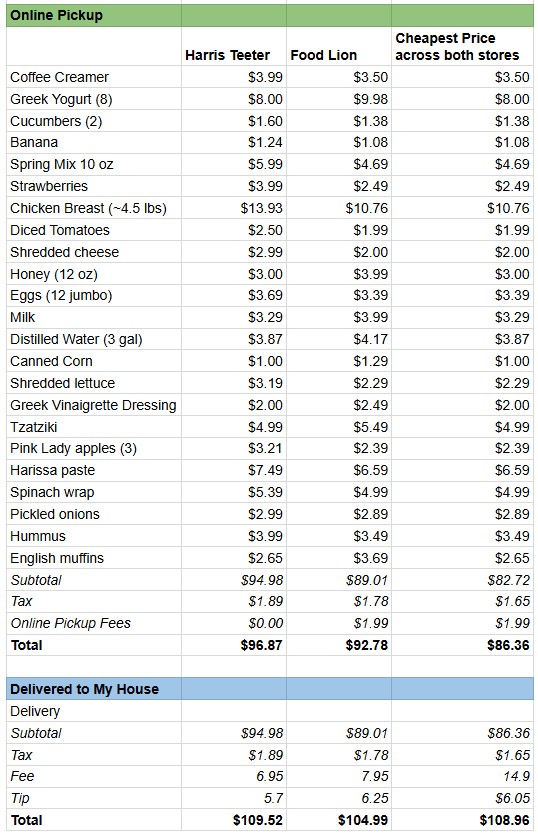
Food Lion was $6.07 (6%) cheaper than Harris Teeter overall, and had the lower price on 15 of 23 items. However, Food Lion has a $1.99 fee for online pickup that brought their net savings down to $4.08 (4%).
Food Lion was significantly cheaper on fresh staples like chicken breast ($3.17 savings, or 29%), strawberries ($1.50 savings, or 60%), and spring mix ($1.30 savings, or 28%). But Harris Teeter made up some ground with a good sale on Greek yogurt ($1.98 savings, or 20%), and English muffins ($1.05 savings, or 28%).
Alternatively, if I did online pickup at both Harris Teeter and Food Lion, I could decrease the total grocery bill to $86.36, which is $10.51 cheaper than shopping only at Harris Teeter, or $6.16 than shopping at just Food Lion. Ultimately, even though it’s a little more expensive, I’m going to continue shopping exclusively at Harris Teeter because it’s slightly more convenient for me to get to.
Delivery adds about 13% to your grocery bill– not worth it unless time is your top priority
The fees are roughly the same at both stores; a $6-7 fee plus a recommended tip of around 6%. This would increase both grocery bills by roughly $12 (13%). I don’t mind picking up the groceries, so this probably isn’t worth it for me. Plus I’ll often need to go inside the store anyway in case I forgot to order something, or need to find a replacement for something that was out of stock online. If you do grocery delivery often, both stores offer membership options for $99 per year that waive the online fee (though you’ll still need to tip).
Amazon can also deliver groceries, although I’m still skeptical
In a subsequent week, I priced out a different batch of groceries on Amazon vs. Harris Teeter. Amazon’s subtotal of $73.24 was slightly cheaper than Harris Teeter’s total of $74.39, however after adding in Amazon’s service fee ($6.95) and tip ($5.00), it’s not very attractive. Plus 1. It seemed inefficient having groceries delivered from the closest Amazon Fresh store, which is 24 miles away in Raleigh. And 2. It’d be difficult to return an item or get replacements for poor substitutions. It could still be worth considering if you were dead set on delivery though since they have very competitive pricing on non-food items that you could otherwise find at the grocery store, like Tums or Naproxen. Note Amazon Fresh also has a $99/year subscription to waive their service fee (which is in addition to an Amazon Prime membership).
In conclusion, there are different ways to prioritize price and convenience (which could include delivery). However, I’m happy with the balance that Harris Teeter online pickup provides in terms of cost, convenience, and quality.
The best way to enjoy a Smirnoff Ice is by making your friends drink it (ideally when they least expect it). After much deliberation, I’m excited to announce the Top 10 Ices Of all Time.
1. George takes a shower
By this point in time, George should have known there was an Ice waiting for him in the bathroom at his bachelor party. I just skewed the odds by putting an Ice in all of the towels… just in case.
2. Sean tries “working from home” at Zach’s bachelor party
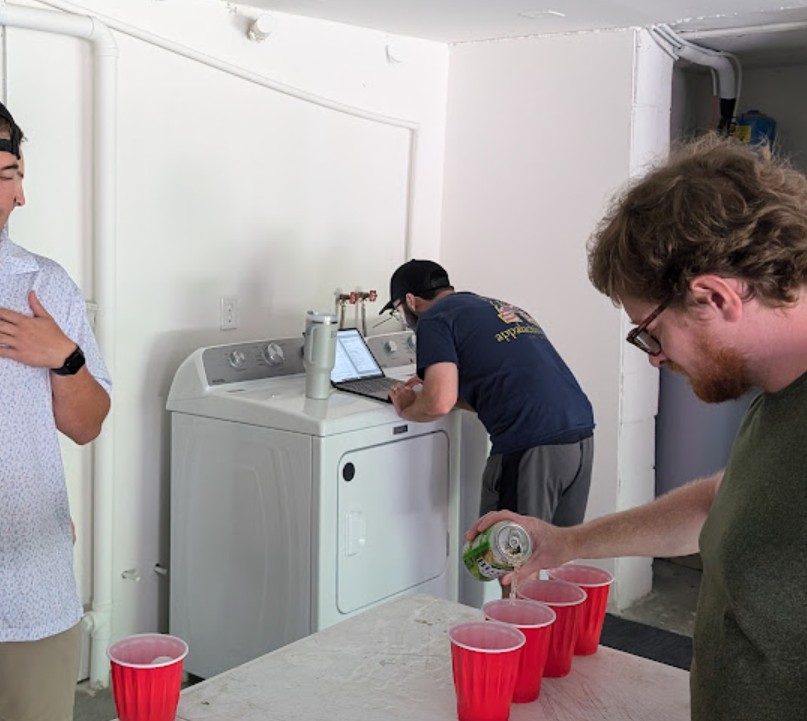
This man deserves a raise for trying to get work done while everyone else was playing beer pong. But little did he know there was a full bottle of Smirnoff Ice sitting inside his water bottle, with the straw perched inside the bottle.
3. George’s formal dinnerware
George is probably my favorite person to Ice because he’s a good sport about it. The scenario below played out at Evan’s wedding– Carter and I slipped into the venue before the wedding started and tucked an Ice into George’s napkin when he sat down.
4. The “Ice” cold birthday cake
With how many Ices I give out, I’m well aware that there’s a huge target on my back. I just didn’t see this one coming. I thought it was a little odd when Carol and Kayla insisted that I cut my own birthday cake, and for good reason… there was an Ice baked right into the cake.
5. Ryan claims his spot as “The Winner of The Losers”
In our fantasy football league, you have to Ice yourself if you score the least amount of points in any given week. Here’s a recap of last year’s Ices– check out the full blog post here.
6. Carter goes 4 for 4 in the Revolution Blind Taste Test
There are somewhere between 18 and 24 unique flavor of Smirnoff Ice. Our group has probably kept Smirnoff in business over the past 10 years, yet somehow only Carter could correctly identify all of the flavors in this variety pack.
7. The Gift of Giving
If you receive a Christmas present from someone in the Revolution, be wary— chances are it’s an Ice waiting to happen.
8. The Easter Beer Hunt
I think Carter actually likes Smirnoff Ice– In fact he’ll often go out of his way to find them. For Easter, George hides beers in his yard instead of Easter Eggs (spoiler alert: there are always Ices mixed in). Several people but pretend not to see the Ices… but not Carter.
9. The wedding party assembles
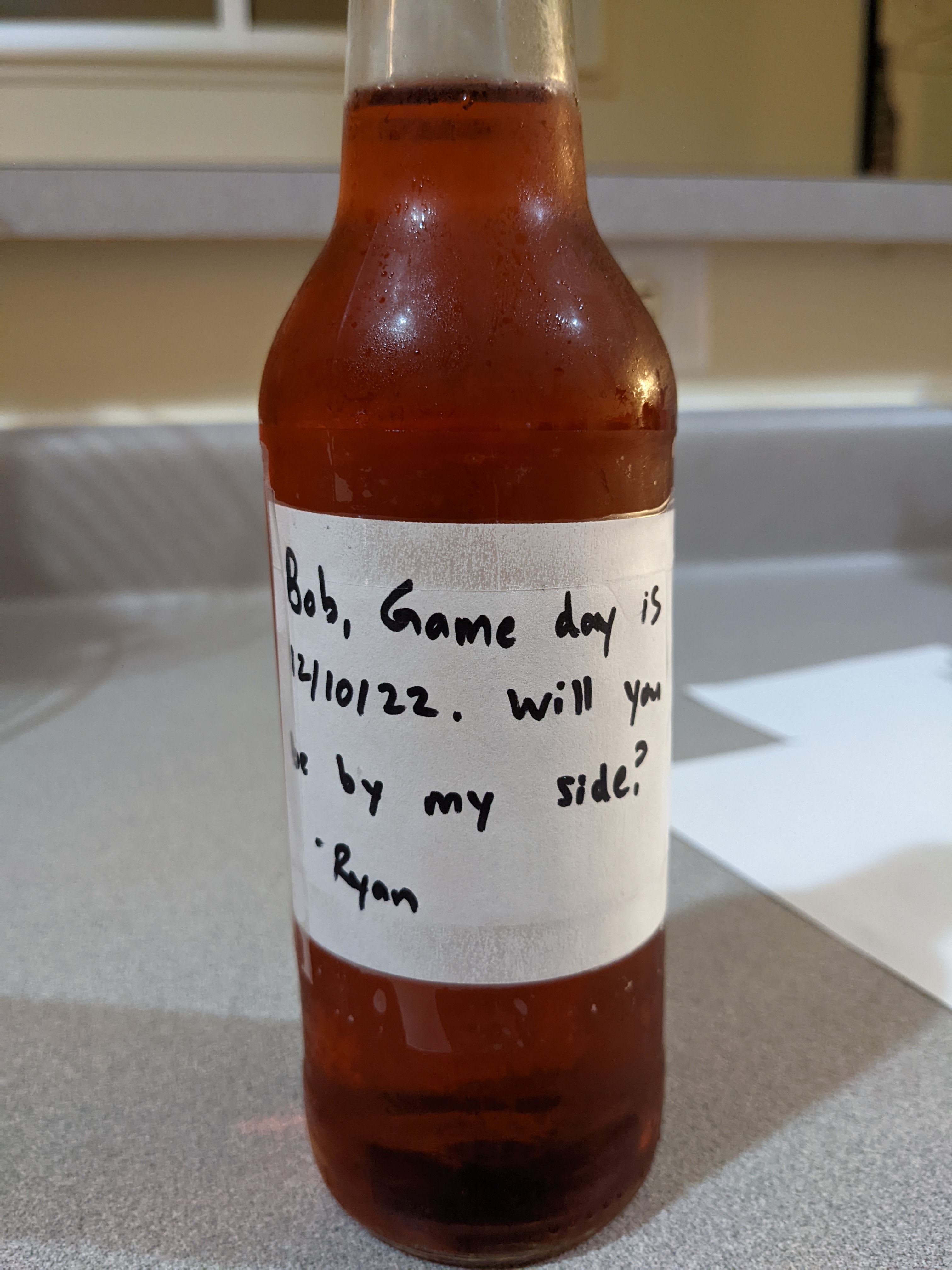
Most people give their friends a gift when asking them to be in their wedding party… These guys all got Ices.
10. Revenge served “Ice” cold
Ugh someone (I think it was Bobby?) got me at my own wedding. I had brought a 12 pack so I could strategically plant some Ices throughout the day but it mysteriously disappeared at some point during the day. Several hours later I go up to the bar to find out everyone else (including the bartender) was in on it.
Honorable Mention: The Long Game
Sometimes the best Ices require delayed gratification. Carol dodged Ices all night but ended up finding a sugary beverage to go with breakfast.
Bonus Content: Andrew shotguns a Fresca
We must’ve run out of Ices this day but Andrew is a legend for taking down a Fresca this quickly.
After 14 years, my HVAC bit the dust. In shopping for a replacement, I spent a lot of time considering this: Should I continue to heat my home with natural gas, or switch to an electric heat pump? Based on the lower operating costs, available rebates, and environmental factors, the heat pump was the clear winner.
What is a BTU?
Before diving into HVAC, let’s review one of the most important units in home heating and cooling: the BTU. BTU stands for British Thermal Unit, and it’s a way to measure energy — specifically, the amount of heat needed to raise the temperature of one pound of water by one degree Fahrenheit.
In HVAC terms, your system is sized based on how many BTUs per hour it can move. A typical home might need 20,000–60,000 BTU/hr depending on climate, size, and insulation. The higher the BTUs, the more heating or cooling power a system can deliver. An HVAC technician can do a load calculation to determine how many BTU’s per hour you need, or you can estimate it yourself using an online tool like this one. My own home, at 2,000 square feet in North Carolina, needs about 22,000–24,000 BTU’s per hour for heating and cooling each floor.
At a glance, Natural Gas is a lot cheaper than Electricity per BTU
Natural Gas is sold in “Therms.” Each Therm is equal to 100,000 BTU’s, and Dominion Energy charges ~$1.29 per Therm.
Electricity is billed in Killowatt-Hours (KwH). Each KwH is equal to 3,412 BTU’s, and Duke Energy charges $0.1185 per KwH.
So the cost of 100,000 BTU’s is $1.29 in Natural Gas or $3.47 in Electricity. Based on that, electricity is ~2.69x more expensive than Natural Gas per 100,000 BTU’s.
However, Electric Heat Pumps can be much more efficient than Natural Gas Furnaces at bringing heat into the home
Gas furnaces burn fuel to generate heat, and gas furnaces aren’t 100% efficient. If you input 1 Therm of Natural Gas (100,000 BTU’s) into a Gas Furnace, you’ll typically only receive an output of 80,000-96,000 BTU’s of usable heat that will be able to help warm your home. The rest of the energy is lost as exhaust. This efficiency is measured as the furnaces’s Annual Fuel Utilization Efficiency, or AFUE. A typical AFUE is 80-96%. For reference, my home’s gas appliance has an AFUE of 80%.
Heat pumps are often more efficient than gas furnaces because they don’t generate heat — they move it. Instead of burning fuel, a heat pump extracts heat from the air outside (even when it’s cold) and transfers it into your home. This process uses far less energy than creating heat from scratch. For example, if it’s 47 degrees outside, my new LG Heat Pump can transfer 3.6 units of heat into the home for every unit of electricity it consumes. This ratio is called the Coefficient of Performance (COP), and it represents the ratio of heat output to electrical energy input. The tricky part is that the COP is a variable number that depends on the temperature outside. If it’s colder outside, the heat pump has to work harder to transfer heat into the home, which means it’ll have a lower COP at lower temperatures.
If it’s really cold outside, some heat pumps can’t keep up and rely on a backup system known as electric resistance heat strips to provide additional heat. Heat strips are built into the air handler and generate heat in the same way a toaster does. They’re 100% efficient (meaning they have a COP of 1.0), however they’re far less efficient than the heat pump, which can carry a COP of 1.5-4 depending on the outdoor temperature. In my case, the analysis below ignores heat strip usage because I’m focusing on a cold-climate rated heat pump that can maintain full heating capacity down to 5°F. Given North Carolina’s relatively mild winters, I don’t expect to rely on the strips under normal conditions.
For example, if it’s 47 degrees outside, the heat pump costs ~40% less per hour to keep my home warm ($0.26/hr vs. $0.435/hr)
In this scenario, let’s assume I’d need ~27,000 BTU’s per hour to keep the inside of my home at 70 degrees. For simplicity, let’s ignore heat loss through the vents etc.
With a Gas Furnace, since my existing gas appliance has an AFUE of 80%, I’d need 33,750 BTU’s of natural gas to produce 27,000 BTU’s of heat inside the home. That means I’d need 0.3375 Therms of Natural Gas, which at $1.29 per Therm, would cost me $0.435. So with a Gas Furnace, it’d cost $0.435 to heat my home for one hour.
With a Heat Pump, to provide the same 27,000 of BTU’s of heat into my home, I’d need to consume 2.2KwH of electricity (which corresponds to a COP of 3.6). At $0.1185 per KwH of electricity, it would only cost me $0.26 to heat my home for one hour.
But as it gets colder, those savings drop. At 30 degrees, the Heat Pump is only 13% more efficient per hour ($0.378/hour vs. $0.435/hour).
Let’s pretend it’s 30 degrees outside now. The Natural Gas Furnace still requires the same amount of Natural Gas to produce 27,000 BTU’s. So the cost there is still $0.435/hour.
But the Heat Pump has to work harder to transfer heat now. To bring 27,000 BTU’s of heat into the home, it now needs 3.19kw of electricity per hour (which corresponds to a COP of 2.55). At $0.1185 per KwH, it would cost $0.378 to heat my home for one hour.
When it’s really cold outside (~22 degrees F or lower), the Gas Furnace is more cost efficient per hour compared to the Heat Pump
The breakeven point is typically when the Heat Pump’s COP drops below ~2.5. Natural Gas is ~2.5x cheaper than electricity, so in order for the Heat Pump to be more cost efficient, it needs to be ~2.5x more efficient with its inputs.
With the Bosch heat pump below (which is very similar to my new unit), this breakeven point happened at 22 degrees F. If it’s warmer than 22 degrees outside, the Heat Pump is more cost effective. But if it’s less than 22 degrees F, the Gas Furnace is more cost effective. In North Carolina, the temperature doesn’t drop below 22 degrees very often, so the Heat Pump should be more efficient on an annual basis.
Overall, I expect this Heat Pump will save ~$336.74 per year in utility costs compared to my existing system
Cooling costs should be ~$182/year (35%) lower with the new system compared to my existing system
I estimate that I spent ~$525.79 on cooling my home last year (which is probably a low-end estimate). During the winter months of November-March (when the AC was off), my average electric bill was $83.68. During the warmer months of April-October (when the AC was on), my average electricity bill increased to $158.79/month. By subtracting those two numbers, I estimate that it cost ~$75.11 per month to cool my home , or ~$525.79 total for the seven months of April-October.
The efficiency of Air Conditioners is measured by its SEER rating (Seasonal Energy Efficiency Ratio), which indicates the amount of cooling produced by a air conditioner for every unit of energy consumed. A higher SEER rating means the unit is more energy-efficient. My existing AC has a SEER 13, whereas the new Heat Pump has a SEER of 17.5. Therefore I estimate that the new system will be ~35% more efficient (17.5/13 -1) than my existing system, which will save ~$182 in annual cooling costs.
Heating costs should be ~$232.95/year (28%) lower with the new system compared to my existing system
Last year, I estimate that I spent ~$545.79 on heating my home (again this is probably a low-end estimate). My average natural gas bill during the summer months of April-October was $42.91, and the heat was off throughout this period. During the colder months of November-March, my average bill was $152.06, suggesting that having the heat on cost ~$109.15 per month on average ($152.06 – $42.91). Based on that, I estimate that the total cost for heating my home was $545.75 for the five month period of November-March ($109.15/month * 5 months).
It’s more difficult to estimate my projected heating costs for next year. I’ll estimate that a rough average temperature for the heating season (November-March) is ~47 degrees F. At that temperature, the new heat pump uses 2.2Kw per hour, and the system would run ~10 hours per day for this 150 day period. At $0.1185/hour, I project it will cost ~$391.05 to heat my home for the season, which is ~28% more efficient than my bill from last year.
Heat Pumps are often more expensive upfront but I should make back the difference pretty quickly through:
The government provides a $2,000 tax credit for upgrading to a high efficiency heat pump.
Duke energy provides ~$825 in rebates for upgrading to a high efficiency heat pump.
The monthly operating costs are expected to be $336.74 less per year compared to my existing system.
Come back next year and I’ll update my analysis with the real-world results.
To help celebrate John’s birthday, Martha put together a blind taste test for seven different apples. Can most people tell the difference between different types of apples?
The answer was a clear “no.”
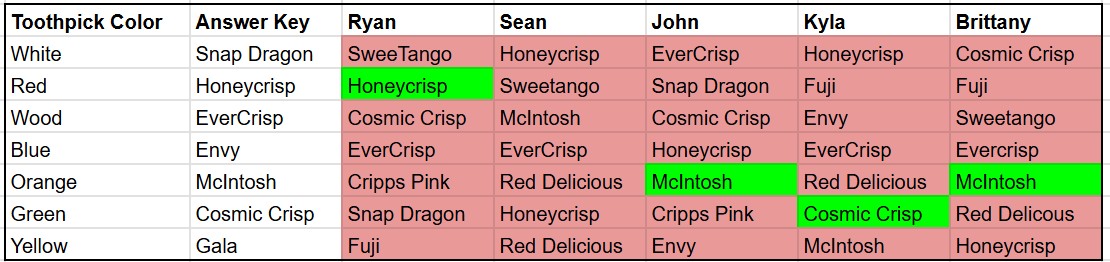
The math suggests we could have guessed the same amount of correct answers just by chance. For example, with each apple, you have a 1 in 9 chance of guessing the right variety since there were 9 options listed in the answer key. So across 7 apples, statistics suggest the average person would get ~0.778 picks correct (1/9 chance of a correct pick * 7 picks). As a whole, our group made 4 correct guesses across five contestants, meaning our group had 0.8 correct picks per person on average (4 correct picks / 5 people). This rate of 0.8 average correct guesses per person was almost exactly even with the blind guessing prediction of 0.778 correct picks per person.
That being said, if you have a favorite apple, you may be able to pick it out of a crowd. Kyla easily picked out her favorite (Cosmic Crisp), and I picked out my favorite (HoneyCrisp). In a way, this helps me justify paying the high price for Honeycrisp at $4.49/lb.
Snap Dragon, EverCrisp, Cosmic Crisp, SweeTango, and Honeycrisp were often confused for each other in the chart below, likely because they’re all similar in flavor and texture.
McIntosh stood out more clearly, maybe because of its distinct softness.
My core friend group is a tight circle that hasn’t changed in over 10 years… until recently. One of the core members got a new boyfriend (thanks online dating) and we’ve decided to fully welcome him into the group. The only problem is this new member hasn’t gotten to spend a lot of time with Bobby yet, who’s apparently too busy being a new parent to hang out with us every weekend now. Whatever. Bobby’s a simple enough guy that I can tell you everything you need to know about Bobby in just a few pictures.
1. Bobby is always hungry. His goal is to put 2,000 calories in every smoothie. And his idea of a side for a bagel is a croissant.
2. He never misses a good photobombing opportunity (especially when he’s in costume)
3. I’m pretty sure he could have been a model.
4. Although he’s also kind of weird.
5. And makes this one face he makes when he’s disappointed (although thankfully we don’t see this one very often).
6. But overall he’s a great friend and gives great hugs.
Almost five years ago today, I was on the fence if meal delivery boxes were worth the added cost. The COVID lockdowns had just gone into effect, and with all restaurants closed, I was looking for new foods and recipes. I also had plenty of time to run a cost-benefit analysis comparing the cost of the meal delivery box to buying the same ingredients at the grocery store.
Since 2020, the Consumer Price Index (an estimate for household inflation) has risen by 22.3% according to the U.S. Bureau of Statistics. So, how much does it cost to buy the same ingredients at the grocery store today vs. in March 2020? And has the value of meal delivery boxes changes? To find out, I’ve tracked, analyzed, eaten, and broken down the costs of four meals over time; Falafel Veggie Bowl, Loaded Black Bean Tacos, Chicken Caprese Sandwich, and Pizza Tortellini.
The cost of ordering these four meals from Dinnerly increased from $51.32 in 2020 to $67.91 in 2025, a 32.3% increase. This means that the cost of meal delivery boxes has risen significantly faster than inflation. And Dinnerly is actually one of the cheaper meal delivery options– a similar box from Hello Fresh would cost $92.73. The only way to argue that a meal delivery box would save money is by comparing it to the cost of eating out. For example, buying four #1 combos for two people at Chickfila would cost $74.05. Or even worse, using Uber Eats to deliver two Crunchwrap Supreme combos from Taco Bell four times would cost $135.
However, despite inflation, the cost of buying these ingredients at Harris Teeter actually went down over time, from $48.78 in 2020 to $47.06 in 2025. This fact doesn’t disprove inflation, rather I think it shows that I hit the sales right this year. The biggest savings came from a sale on taco seasoning ($1.99 down to $0.59), buns and tortellini (both down $1.01), and tortillas (down $0.99). Meanwhile, staples like cheese, chicken, and tomato sauce were all up (21%, 8%, and 79%, respectively).
In 2020, the added cost of ordering the meal delivery kit was only $2.52 per week, or around 5%, which I thought was worth. However, today that premium has increased to $20.85 per week, or 44%. Meal delivery boxes may still make sense for people who eat out for every meal or value convenience over cost. But for the rest of you, I’ll see you at Harris Teeter.
The rules of our Fantasy Football Football league are pretty simple: if your team scores the least amount of points across the entire league for the week, you have to chug a Smirnoff Ice and send video proof to the group.
There are 10 teams in the league but only four of us have had the (dis)honor of being the biggest loser of the week. But of these losers, who’s the winner with the fastest chug?
Video replay confirms that yours truly is the undisputed winner of the losers, sweeping first, second, and third place. Props to Carter though for stepping up with a massive 24 oz. Smirnoff Ice—double the size of everyone else’s—and taking it down like a champ (featured in the top left and top middle-right squares of the video). Zach snagged 5th, 6th, and 7th place, earning a few brownie points for the unique backdrops in his videos. Will, in his rookie season, faced a tough initiation with subpar performances both on and off the field.
Welcome to the big leagues, where even the losers can be winners—if they can chug fast enough.
My dad was a general contractor so I used to hear those words a lot growing up. Well, I’ve been hearing them (and saying them) a lot lately too…
Since Brittany and I bought our house in June 2022, we’ve been to Lowe’s 94 times over the course of about two and half years, or about once every 10 days. My personal record was five trips in one day when I was trying to figure out the right size pipe and fittings to install a new sink (fifth time was the charm).
Cost wise, we’ve spent $6,075.84 at Lowe’s since buying the house, according to our credit statements. That’s about $65 per trip, however that average was skewed by a few large purchases including a new oven (~$1200) and 15 gallons of paint to stain the fence (~$600). The median of $31 is probably a better representation of our standard trip to Lowe’s.
To be clear though, our house wasn’t in bad shape by any means when we bought it. However we’ve been trying to flex our DIY skills as we’ve learned how to do routine maintenance (like taking care of the lawn), basic repairs (like changing the garbage disposal), and also some tasteful upgrades (like updating the bathroom). Take a look at my last DIY blog to follow along with some of the projects we’ve tackled.
While spending $6,000 over 2.5 years sounds like a lot, homeguide.com estimates that home maintenance costs between 1-4% of a home’s value per year. We’ve certainly had to spend money at other places (i.e. 14 trips to Home Depot costing a total of $779.71), however we’re still probably on the lower end of that spectrum given that we’ve done a lot of the work ourselves. Rather than money, we’ve paid the price with our time… and trips to Lowe’s.
So next time you hear someone talking about the “joys of home ownership,” it really just means going to Lowe’s.
Can you guess where on the graph we bought the house?
A little over two years ago, our dear friend Terry was trying to figure out what to say at our wedding. It was her first time officiating a wedding and to put it simply, she wanted to know why I wanted to marry Brittany. Here’s how I responded on Thanksgiving Day 2022.
Hi Terry, Today especially, it makes sense to be thankful for Brittany on Thanksgiving. I know you’ve seen the photobooks of us smiling and posing for different occasions, but the best part of our relationship is really what happens in between those photos. Brittany is caring, sharp-witted, and full of love, which makes loving her so easy.
Brittany is caring
At times, I’d swear she was an angel. Earlier this year, I was sick for a full two weeks. Most people would have stayed away, or given up on me after a few days, but Brittany kept the tea kettle warm and would check on me in the middle of the night. I’ll never forget the compassion she showed as she poured warm water through my hair in the bathtub, bringing me back to life. This compassion extends to other people as well. A few years ago, we were driving through Chapel Hill and witnessed a terrible car crash, with one of the cars spinning twenty feet down a ravine and into a fence. Brittany instinctively pulled our car into a safe spot and ran down the slope to check on the driver. Another time, and very early in our relationship, Brittany got stuck taking care of both me and my dad at the same time after I’d just gotten my wisdom teeth taken out and my dad was recovering from a significant hip surgery. Brittany juggled both tasks with a smile… way above the call of duty for any caretaker, let alone a new girlfriend at the time. For my dad, an extra blanket in the middle of the night made a world of difference and cemented her status as an angel in the Kelley household. Her empathy and compassion seem to have no end, which makes her both a good medical provider and an easy choice for my lifetime partner.
Brittany is smart
And when she puts her mind to something, nothing can stop her. There was a brief period early in our relationship where Brittany and I were spending so much time together that her grades began to slightly slip. She was taking Calculus 2, an important prerequisite for pursuing a career in the medical field, and wasn’t happy with her first test grade. She looked me in the eyes and said, “I’m going to get an ‘A’ in this class.” Our dates quickly changed from ice cream and Old Chicago pizza to meeting up in Davis Library. But the results came quickly too; I don’t think she ever got anything less than ‘A’ throughout the rest of her time in school, including her master’s degree at ECU. Brittany’s not one to brag, but she scored in the top 1% of all PA school students on the final board exam. Plus, she’s not just school smart. She’s also good at answering my common questions like “what should we make for dinner?”, “what day was that event again?”, or “do you know where I left my shoes?”
Brittany has a kind and tender heart, and I’m so thankful she has chosen to share it with me
The sweetness and sincerity of her love is undeniable. If she has an early morning, she’ll leave a handwritten note on the counter to wish me a good day. When I get home in the afternoon, she’ll be waiting for me at the door with a warm embrace or a round of applause (silly but my favorite). Her favorite way to wake up in the morning is with a kiss on her forehead and a big smile on her face. I’m pretty sure she doesn’t know how to walk beside me without holding my hand. She’s the most thoughtful planner and gift-giver for birthdays and holidays. These may seem like little things, but they mean a lot and provide a snapshot of why I can’t wait to marry Brittany.
This list could just have easily been a hundred pages long but Brittany’s compassion, intelligence, and kind heart are just three of the reasons why I love her. I can confidently look forward to our wedding without any nerves and a lifetime of happiness to follow.
As we’re celebrating our two-year anniversary today, I’m happy to report back that things are better than ever. Just take a look at the cover photo here– we’re so in sync that we even got each other the same anniversary card.
Our local produce stand has a deal where you can fill a bag with as much fruits and vegetables as you want, plus a free item of their pick, for a fixed cost of $25. As a numbers person, I wanted to know– is this a better deal than going to Harris Teeter?
This week, the answer was yes. I only spent $25 at Perkins whereas those same items at Harris Teeter would have cost $26.24, plus I felt good knowing the produce was fresh and locally sourced. If you only need a few things though, it probably makes sense to pay by the item.
Another pro of Perkins– they sell a lot of pumpkins! In typical fashion, they’ll sell you as many pumpkins as you can fit in a wagon, plus a bag of produce, for the reasonable cost of $100.